

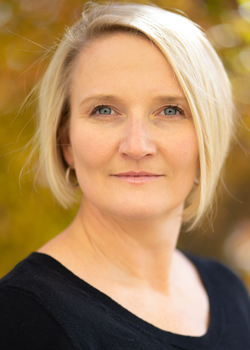
Shannon Forrester (she/her)
Acting Associate Dean and LecturerResearch Area(s)
- Youth health and development
- Healthy aging and management of chronic conditions
- Scholarship of Teaching and Learning (SoTL)
Education and Professional Certifications
- B.Sc.(with Distinction) Physical Education (1998), University of Saskatchewan
- M.Sc., Kinesiology (2001), University of Saskatchewan
- Clinical Exercise Physiologist (1998), Canadian Society for Exercise Physiology
- High Performance Specialist (2019), Canadian Society for Exercise Physiology
- Bone Fit Foundations (2025), Osteoporosis Canada
Teaching and Research Areas
Shannon believes that meaningful relationships are at the heart of learning. As a student-centered educator, she creates inclusive, supportive, and engaging learning environments where students feel valued, challenged, and empowered to succeed. Drawing on nearly two decades of teaching experience across diverse programs, she integrates evidence-informed teaching practices, authentic learning opportunities, and community engagement to support both academic achievement and personal growth. Her teaching emphasizes belonging, curiosity, sustainability, and real-world application, encouraging students to think critically, develop confidence, and contribute positively to their communities and professions. Through reflection, mentorship, and continuous growth, Shannon fosters learning that extends beyond the classroom.
“It is my hope that students carry forward a strength-focused, compassionate approach to movement. One that honors diverse perspectives, values inclusion, and supports both personal and collective well-being. I encourage thoughtful, evidence-informed physical activity promotion that is adaptable and empowering. Practices that help people build confidence, resilience, and connection, while respecting the health of individuals, society, and the planet.” S. Forrester, 2026
Shannon’s research is guided by the same principles that shape her teaching: meaningful relationships, inclusion, and student success. As a scholar-practitioner, she explores how educational environments can foster belonging, engagement, well-being, and authentic learning. Through collaborative and interdisciplinary inquiry, she seeks to generate knowledge that informs teaching practice and supports diverse learners in achieving their potential.
Grounded in the Scholarship of Teaching and Learning, her research focuses on creating equitable and impactful educational experiences with relevance for students, educators, and communities. She is committed to research that bridges theory and practice, contributes to positive change in postsecondary education, and supports lifelong learning, resilience, and meaningful community engagement.
Recognitions:
- Provost’s College Award for Outstanding Teaching (College of Kinesiology, University of Saskatchewan), 2026
- Education for Sustainable Development Recognition Award (RCE Saskatchewan), 2025
- Lieutenant Governor’s Post-Secondary Teaching Award – Distinguished Teacher (Province of Saskatchewan), 2024
- Provost’s Award for Outstanding Teaching (University of Saskatchewan), 2024
- Sustainability Faculty Fellow (University of Saskatchewan), 2022–2024
- Education for Sustainable Development Recognition Award (RCE Saskatchewan), 2023
- USSU Teaching Excellence Award (University of Saskatchewan Students’ Union), 2019–2020
- Provost’s College Award for Outstanding Teaching (College of Kinesiology, University of Saskatchewan), 2017
Courses Taught
- Kin 121.3 – Functional Basis of Physical Activity
- Kin 122.3 – Social Behavioral Foundations of Physical Activity
- Kin 146.3 – Physical Activity in School Aged Children and Youth
- Kin 150.3 – How the Body Moves
- Kin 223.3 – Contemporary Health Issues
- Kin 225.3 – Introduction to Exercise Physiology – Neuromuscular and Metabolism
- Kin 226.3 – Introduction to Exercise Physiology – Cardiorespiratory, Thermoregulation, and Obesity
- Kin 281.3 – Fitness Foundations for Life
- Kin 424.3 – Aging and Physical Activity
Recent presentations/publications
Forrester, S. and Daud Sha, B. (2026). Kinesiology Student Responses to an Instructor Disclosure of Mental Illness: The Role of Social Identity. International Society for the Scholarship of Teaching and Learning 2026 Conference, Saskatoon, SK. October 28 – 31, 2026 (Accepted)
De Barros, C., Croteau, T..; Forrester, S., Bradford, L., Jaunzems Fernuk, J.; Bergen, J. Horwitz, S., Wellsch, J., Squires, V., and Gelech, J. (2026). Perceived Changes in Attitudes and Behavioral Intentions Among Postsecondary Students Following Instructors’ Disclosures of Mental Illness and/or Neurodiversity. Journal of Education. (Accepted)
Horwitz, S., Gelech, J., Wellsch, J., de Barros, A. C., Croteau, T., Bergen, J., Forrester, S. Bradford, L. and Jaunzems Fernuk, J. (2025). Postsecondary instructors’ disclosures of mental illness and neurodiversity in the classroom: motives and means suggest four disclosure types. Teaching in Higher Education, 1–23. https://doi.org/10.1080/13562517.2025.2521377
Forrester, S., Jordan, J., Gelech, J. & Jaunzems-Fernuk, J. (2025). Exploring Student Reactions of Instructor Mental Illness or Neurodiversity Disclosures in Post-secondary Classrooms. Society for Teaching and Learning in Higher Education Annual Conference, Saskatoon, SK, June 10 – 13, 2025.
Jordan, J., Gelech, J., Forrester, S. & Jaunzems Fernuk, J. (2025). Classroom Revelations: Students Speak to Impacts of Instructor Disclosures of Mental Illness and/or Neurodiversity. Presented at the Canadian Psychological Association National Annual Convention. St John’s, Newfoundland. June 12 - 14, 2025
Jordan, J., Gelech, J., Forrester, S., Jaunzems-Fernuk, J. (2025). Postsecondary Students’ Perspectives on Instructor Disclosures of Mental Illness and/or Neurodiversity in the Classroom: A Qualitative Inquiry presented at University of Saskatchewan Department of Psychology and Health Studies Annual Undergraduate Conference, Saskatoon, SK. April 2025
Jordan, J., Gelech, J., Forrester, S. & Jaunzems Fernuk, J (2025, June 12–14). [Abstract of conference presentation]. Canadian Psychological Association Annual Convention, St. John's, NL, Canada. https://cpa.ca/docs/File/Convention/2025/Abstract%20Book%202025-v1.0.pdf
Forrester, S. (2024). Addressing Social, Economic and Environmental Sustainability from a PHE Context. Presented at Physical and Health Education Canada National Conference. Saskatoon, SK. May 1 – 3, 2024
Garg, A., Klassen, B., Micheels, E., Ross, H.M., Congreaves, K., Forrester, S., Cao, T. & Teucher, U. (2024) Cultivating Change: A Prairie Guide to Sustainability Teaching and Learning Practices. OpenPress.
Forrester, S., Klassen, B., & Teucher, U. (2023). The fellowship of the (SDG) ring: Using open education practices to promote sustainability in teaching and learning. Presented at Open Education Global. Edmonton, Alberta. October 16-18, 2023.
Squires, V., Bergen, J., Forrester, S., & Jaunzems Fernuk, J. (2023). I didn’t know that! Learning from colleagues in our SoTL journey. Presented at Society for Teaching and Learning in Higher Education. Charlottetown, PEI.
Bergen, J.; de Barros, C., Galech, J., Forrester, S., Horwitz, S., and Squires, V. (2021, Jan 18). Should university instructors disclose mental health conditions? It's complicated.
The Conversation. https://theconversation.com/should-university-instructors-disclose-mental-health-conditions-its-complicated-172583
The National Post. https://nationalpost.com/pmn/news-pmn/should-university-instructors-disclose-mental-health-conditions-its-complicated/wcm/82ec10b5-544d-43c5-9ec3-58a0cd57ddf6/amp/
Academica Group. https://www.academica.ca/topten
Andrushko, J.W., Gould, L., Renshaw, D.W, Forrester, S., Kelly, M.E., Linassi, G., Mickleborough, M., Oates, A., Hunter, G., Borowsky, R., & Farthing, J.P. (2021). Ipsilesional motor cortex activation with high-force unimanual handgrip contractions of the less-affected limb in participants with stroke. Neuroscience. 2021 Jan 1;452:111-125. doi: 10.1016/j.neuroscience.2020.10.031. Epub 2020 Nov 13.
Forrester, S. (2021). Enhanced focus through the incorporation of physical activity breaks into a second year kinesiology course. Presented at It’s Been SoTL Long: A Scholarship of Teaching and Learning Event, Saskatoon, SK.
Sultan, Z. & Forrester, S. (2021). The Effects of an Acute Bout of Moderate to Vigorous Physical Activity on State Anxiety and Test Performance. Presented at It’s Been SoTL Long: A Scholarship of Teaching and Learning Event, Saskatoon, SK.
Gould, L., Farthing, J., Forrester, S., Renshaw, D., Andrushko, J., Borowsky, R., & Kelly, M. (2017). Cross-Education Rehabilitation for Hemiparesis After Stroke: A Behavioural and fMRI Study. Presented at Canadian Stroke Congress, Calgary, AB.
Gould, L., Farthing, J., Forrester, S., Renshaw, D., Andrushko, J., Borowsky, R., & Kelly, M. (2017). Cross-Education Rehabilitation for Hemiparesis After Stroke: A Behavioural and fMRI Study. International Journal of Stroke, 12(4): p.88
Gould, L., Farthing, J., Forrester, S., Renshaw, D., Andrushko, J., & Kelly, M. (2017). Cross-education for improving hemiparesis post-stroke: A behavioural and neuroimaging study. Canadian Journal of Experimental Psychology. Presented at the Canadian Society for Brain, Behaviour, & Cognitive Science (CSBBCS), Regina, SK
Gould, L., Farthing, J., Forrester, S., Renshaw, D., Andrushko, J., & Kelly, M. (2017). Neurobiological and behavioural outcomes following cross-education for hemiparesis post-stroke. Poster presented at the Banff Annual Seminar in Cognitive Science (BASICS), Banff, AB.
Current Funding
Forrester, S. (2026-2028). Exercise Physiology Open Education Resource Project. Gwenna Moss Centre for Teaching and Learning, University of Saskatchewan.
Project Description:
This project supports the development of an open educational resource (OER) for undergraduate exercise physiology courses in the College of Kinesiology by adapting and integrating existing open textbooks into a single, comprehensive resource tailored to the Canadian context. The project aims to improve student learning while removing financial barriers by providing free access to high-quality course materials.
A central feature of the project is its commitment to social justice. Guided by principles of redistributive, recognitive, and representational justice, the resource will increase equitable access to learning materials, incorporate diverse and inclusive examples and case studies, and better reflect a wide range of identities and experiences within exercise physiology. The project also includes meaningful student engagement through the hiring of undergraduate and graduate student contributors, with particular attention to supporting women, who remain underrepresented in the exercise physiology field.
By embedding equity, accessibility, and representation into both the content and development process, the project seeks to create a more inclusive learning environment and model socially just approaches curriculum design.
Academic Mental Illness Project (AMIP) website: https://sites.usask.ca/amip/